It would appear that poppies have long been companions of the human race. Archaeological evidence suggests that there use dates back as far as Neolithic times, implying that they once played a significant role in human culture. Opium and
poppy remains have been found at Neolithic settlements and burial sites all over the Mediterranean. Moreover, in the Eleusinian Mysteries (an ancient ritual adopted by the Greeks and the most prestigious in the Classical world) Demeter and Persephone play the central roles. Although much of the actual initiation has long been lost, archaeologists believe it was related to the worship of The Goddess, and goes back much further than the classical Greek Gods. Sadly, it was forcibly ended by the Christian Emperor Theodosius in 392AD - the Goddess was seen to be too powerful and too dangerous to the new Christian religion and, above all else, they feared her.
Poppy Goddess
So who was this Goddess that the Christians feared and appeared to be older than time itself? Archaeologists have discovered representations of the goddesses in Europe, Asia, Australia, and Africa. Figurines, paintings, and relief sculptures dating back as far as 40,000 BCE prove that, since humans first developed a consciousness of the divine, they worshipped a goddess. Scholars suggest that this reverence for the female stemmed from a woman’s mystical abilities to create new life. Creation stories were spun, and the Goddess was celebrated as the Creatrix of life and images were painted and carved in her honer. One of the most famous is the Venus of Laussel, a 26,000 year-old relief carving found in a cave in France. This is a woman holding a horn in one hand while resting her other hand on her belly.
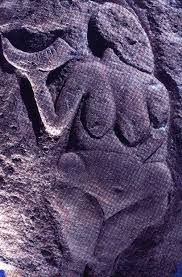
The nude female figure is holding a wisent horn in her right hand. Some think it may be a cornucopia. The horn has 13 notches which may symbolize the number of menstrual cycles or moons in one year.
Looking at the etymology of the name Demeter you will find that, in fact, it in no way relates to her being simply an 'earth mother' (although most popular sources still perpetuate this). Eric Partridge, the famous philologist, believes that what we actually have is de-meter - God Mother; often anciently abbreviated to deo - simply, God. Therefore, it makes sense to assume that Demeter was a goddess incorporated into the patriarchal pantheon of Greek gods and important enough to be the main protagonist in their Eleusinian initiation. Archaeologist, Marija Gimbutas, in her digs in Italy, Greece and Turkey discovered artifacts that gave more evidence of Goddess worship. She found hundreds of stone, bone and ceramic figures dating from 7,000 BCE to 3,000 BCE depicting symbols derived from nature and representing feminine energy in all it's glory. This prevalence of female figurines, with their beautiful, symbolic designs and a notable absence of weapons and warfare, led Marija to believe that in Neolithic Europe, women, the Goddess and the giver of life, were venerated and worshipped. Furthermore, she concluded that these were egalitarian societies in which women and men were equal and were partners in every sense of the word. So what became of this matristic culture (note: not matriarchal as this arouses the idea of dominance and can be compared with patriarchy) and why is it not being promoted?

Marija Gimbutas
Marija was one of the first archaeologists to realize that the culture of the Indo Europeans, who arrived in Europe from the Russian Steppes, was entirely different from the one it supplanted. These invaders were warriors and their gods were warrior gods; the Sky God, the God of the Underworld and the Thunder God. The symbolic nature of these two cultures was also expressed in their social structure. The Indo Europeans had weapons and horses (the horse appeared only with the invaders) and in old Europe there were no weapons other than for hunting. The old Europeans were agriculturists, living in the same area for a very long time and in the most beautiful of places. When the warriors arrived, they established themselves high in the hills, sometimes in places which had very difficult access. In each aspect of culture there appears to be opposition - the matristic v the patriarchal. There is archaeological evidence that suggests this clash of culture had a devastating effect on the old Europeans. The dominating culture who had the weapons, the horses, the smaller families and were mobile, ie the Indo Europeans, were the victors.

Demeter and Persephone
However, the Goddess survived, albeit in the guise of pretty consorts to the warrior Gods. The Greek story of Demeter and her daughter are the remnants of a much older story of death and rebirth. If
de-meter was, indeed, a 'God Mother', who had a daughter that died and was reborn so that the mortals could be saved, you can begin to understand why the Christians feared her. It certainly does appear to be some strange feminine parody of Christianity. The death and resurrection of the Child of God is one of the oldest stories in the world, and the feminine version long predates the masculine. It is preserved in the cultus of Demeter and Persephone, which proved too strong to entirely eradicate.

Hello my sister Annie. A fine wrap up to the trilogy on the poppy. Proven through the annals of history is the fact Gaia transitions at the behest of Astrological cycles. From maternal expression to paternal and back yin cedes to yang. Times of darkness are usually reflected by the paternal organization of societal rule whilst light shines through the goddess. We are presently shifting into the age of Aquarius. Finally fear will be released by humanity inf favour of love.
ReplyDeleteIn Lak' esh, my sister, a time for love...
Thank you, Christopher. I'm enjoying this strange little journey. It's all new and shiny to me :-)
ReplyDelete