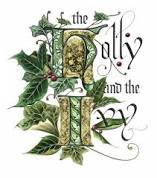
For the remainder of December I had decided to concentrate on the simplicity and beauty of winter flowers and plants, however, it soon became apparent that this newly found Goddess (well, new to me) just wasn't going to let go that easily. For many years, myself and my husband ran a horticultural nursery and, in the winter, it was my job to make the wreaths and garlands for the local florists. I continue to do this, although my husband is now a landscaper and we no longer have the nursery. I enjoy doing this work and I'm aware and at ease with the change and flow of the seasons. However, I never really looked deeply into the symbology of the plants or the spirituality of the ever changing seasons. I didn't feel a need to do this because, due to the nature of working the land, I just kind of felt it. So, it was my intention to upload a couple of pictures of holly wreaths with maybe a youtube of Annie Lennox singing 'The Holly and the Ivy' from her new Christmas album, 'A Christmas Cornucopia'. I thought it would be a good idea to look into the history of this, apparently, Christian Christmas carol, with the intention of bulking the blog out a bit. However, it was at this point that the Goddess prodded me to open my eyes a wee touch more.

When they are both full grown
Of all the trees that are in the wood
The holly bears the crown
O the rising of the sun
And the running of the deer
The playing of the merry organ
Sweet singing of the choir
The holly bears a blossom
As white as lily flower
And Mary bore sweet Jesus Christ
To be our sweet Saviour
O the rising of the sun
And the running of the deer
The playing of the merry organ
Sweet singing of the choir
The holly bears a berry
As red as any blood
And Mary bore sweet Jesus Christ
To do poor sinners good
O the rising of the sun
And the running of the deer
The playing of the merry organ
Sweet singing of the choir
The holly bears a prickle
As sharp as any thorn;
And Mary bore sweet Jesus Christ
On Christmas Day in the morn.
O the rising of the sun
And the running of the deer
The playing of the merry organ
Sweet singing of the choir
The holly bears a bark
As bitter as any gall;
And Mary bore sweet Jesus Christ
For to redeem us all.
O the rising of the sun
And the running of the deer
The playing of the merry organ
Sweet singing of the choir
The holly and the IvyNow both are full well grown,
Of all the trees that are in the wood,
The holly bears the crown.
O the rising of the sun
And the running of the deer
The playing of the merry organ
Sweet singing of the choir
Looking at the lyrics of the Holly and the
Ivy, it is clear that it is full of Christian symbolism. The general consensus is that:
- Holly's "white as lily" flower in the second stanza is an allusion to Christ's purity, through Mary.
- In the third stanza, a correlation is drawn between the red colour of holly's berry and Christ's blood.
- Holly's thorny "prickle" in the fourth stanza is an allusion to the "crown of thorns" worn by Christ.
- And the bitter taste of holly's bark mentioned in the fifth stanza could be a reference to the drink offered Christ as he hung on the cross.
However, for a carol to be written about both the Holly and the
Ivy, there is very little mention of dear old
Ivy. Looking into the symbology of the
Ivy I found, lo and behold, it is associated with Lunar Goddesses, and in pagan rituals it is used to enable them to open the portals to the 'Other World', or more specifically, the 'Dark Side of the Moon'. Thus,
Ivy was representative of the mysterious and the mystical and was symbolic of the journey of the soul toward the self. It encouraged assistance toward others in their search so that they, in turn, might offer assistance. And, relating to its growth, the
Ivy grows in the shape of a spiral which the ancients considered a sacred symbol for:
Consciousness
Development
Expansion
Rebirth
Also, Ivy's five-pointed leaves depicts a symbol of the harmony between the four elements, unified by the one common bonding energy:
- Fire
- Water
- Earth
- Air
- Spirit
Pondering all of the above, I began to suspect that maybe the Christian version of the 'Holly and the
Ivy' had an older, much more pagan, version of the song. With a little bit more digging and a lot more googling I did, indeed, find the original. Called 'The Contest of the Holly and the
Ivy' it was written in medieval times and appears to be a remnant of a defeated Goddess:
The Contest Of The Ivy And The Holly
Nay,
Ivy, nay, it shall not be, I wis,
Let Holly have the mastery as the manner is.
1 Holly standeth in the hall fair to behold,
Ivy stands without the door; she is full sore a cold.
Nay,
Ivy, nay,
2. Holly and his merry men, they dancen and they sing;
Ivy and her maidens, they weepen and they wring.
Nay,
Ivy, nay,
3. Ivy hath a lybe, she caught it with the cold,
So may they all have, that with
Ivy hold.
Nay,
Ivy, nay,
4. Holly hath berries, as red as any rose,
The foresters, the hunters, keep them from the does.
Nay,
Ivy, nay,
5. Ivy hath berries as black as any sloe,
There come the owl and eat them as she go.
Nay,
Ivy, nay,
6. Holly hath birds a full fair flock,
The nightingale, the poppinjay, the gentle laverock.
Nay,
Ivy, nay,
7. Good
Ivy, what birds hast thou,
None but the owlet that cries How! How!
Nay,
Ivy, nay.
As you can determine from the above, it seems that there is some sort of battle going on between the Holly (male) and the
Ivy (female). Furthermore, the
Ivy plays an equal role to that of the Holly in this version of the song. To all intents, it would appear that the writer of this version was aware, consciously or not, of the patriarchal take over of the female Goddess. However, the influence of this earlier version was apparently so strong that the
Ivy was given a cameo appearance in the much later Christian one too -- despite the fact that only the holly has any major role to play in it. Below is another medieval carol which I came across, only in this rendition, it is the
Ivy which wins the day.
Ivy Queen of Trees, She Is
The most worthye she is in towne -
She is the worthiest in the world -
He that seith other do amiss -
Those who say otherwise, are wrong
(And) worthy to ber the crowne.
And she is worthy to bear the crown.
Veni, coronaberis.
Come, you shall be crowned.
Ivy is soft and mek of spech,
Ivy is soft of speech, and mild,
Ageinst all bale she is blysse.
In the face of evil she stands for good.
Well is he that (may) her rech.
He who attains her is blessed indeed.
Veni, coronaberis.
Come, you shall be crowned.
Ivy is green with colour bright,
Ivy hue is brilliant green -
Of all trees best she is,
Among trees, she is the most exalted -
And that I preve well now be right.
And now the truth I prove to you:
Veni, coronaberis.
Come, you shall be crowned.
Ivy bereth beris black.
Ivy bears berries of deepest black -
Goddess graunt us all your blisse,
Goddess grant that we all reach you at last
For there shall we nothing lack.
For in that place we shall nothing lack.
Veni, coronaberis.
Come, you shall be crowned.
There are many accounts of the
Ivy also being a symbol of survival and determination. It seems to be virtually indestructible and will often return after it has suffered damage or has been severely cut back. This symbology represents the survival of the human spirit and the strength we all have to carry on regardless of how harrowing our setbacks may have been. And perhaps, more importantly, it is symbolic of the
Ivy Goddess herself, whispering to us all that she will one day return. I hope so.


